Marine gases influence the Arctic climate through aerosols and clouds
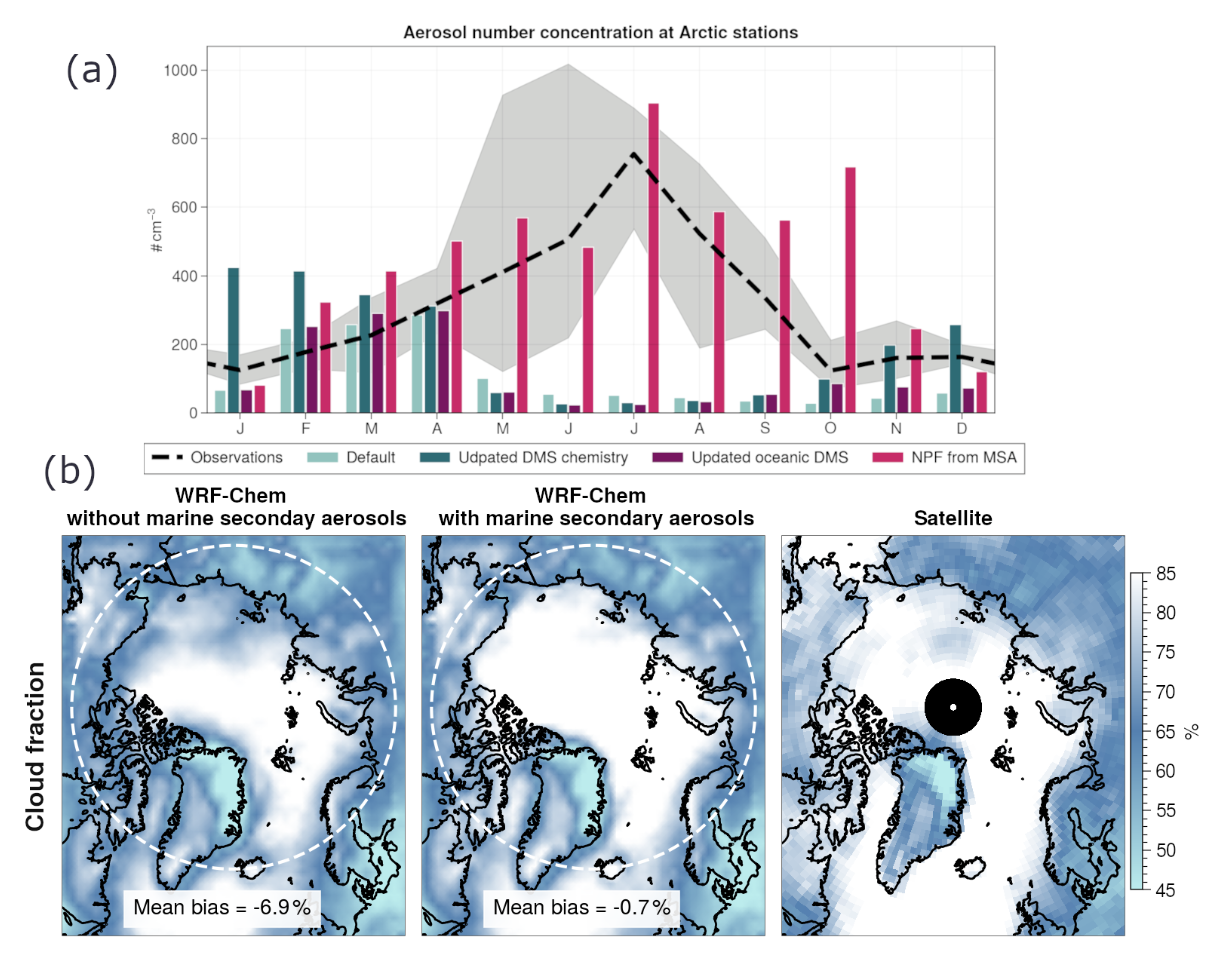
Marine precursor gases and aerosols are critical for the Arctic climate. A new study by Lapere et al. (2026) investigates the impact on simulated Arctic aerosols, clouds and surface radiation of (i) different representations of dimethyl sulfide (in the atmosphere and in the ocean), and (ii) new particle formation from marine biogenic precursor gases, using the regional chemistry-climate model WRF-Chem.
While a more complex and detailed approach for (i) leads to improvements in simulated gases, only by activating (ii) does WRF-Chem reproduce the annual cycle of aerosol number (Fig. a). Activating marine new particle formation then considerably reduces the bias on clouds (Fig. b) and surface radiation. This work provides insights for climate models to improve their representation of the Arctic.
The scientists involved in this work were brought together thanks to the CRiceS European project and the SOLAS-sponsored communities BEPSII and CATCH.
Reference: Lapere, R., Haddon, A., Price R., Marelle, L., Monahan, A. H., Steiner, N., Raut, J-C, Bastien, L., Willis, M., Thomas, J. L. (2026). Marine secondary aerosols are required for modeling clouds in the Arctic. Geophys. Res. Lett., 53(13), e2026GL121724. https://doi.org/10.1029/2026GL121724