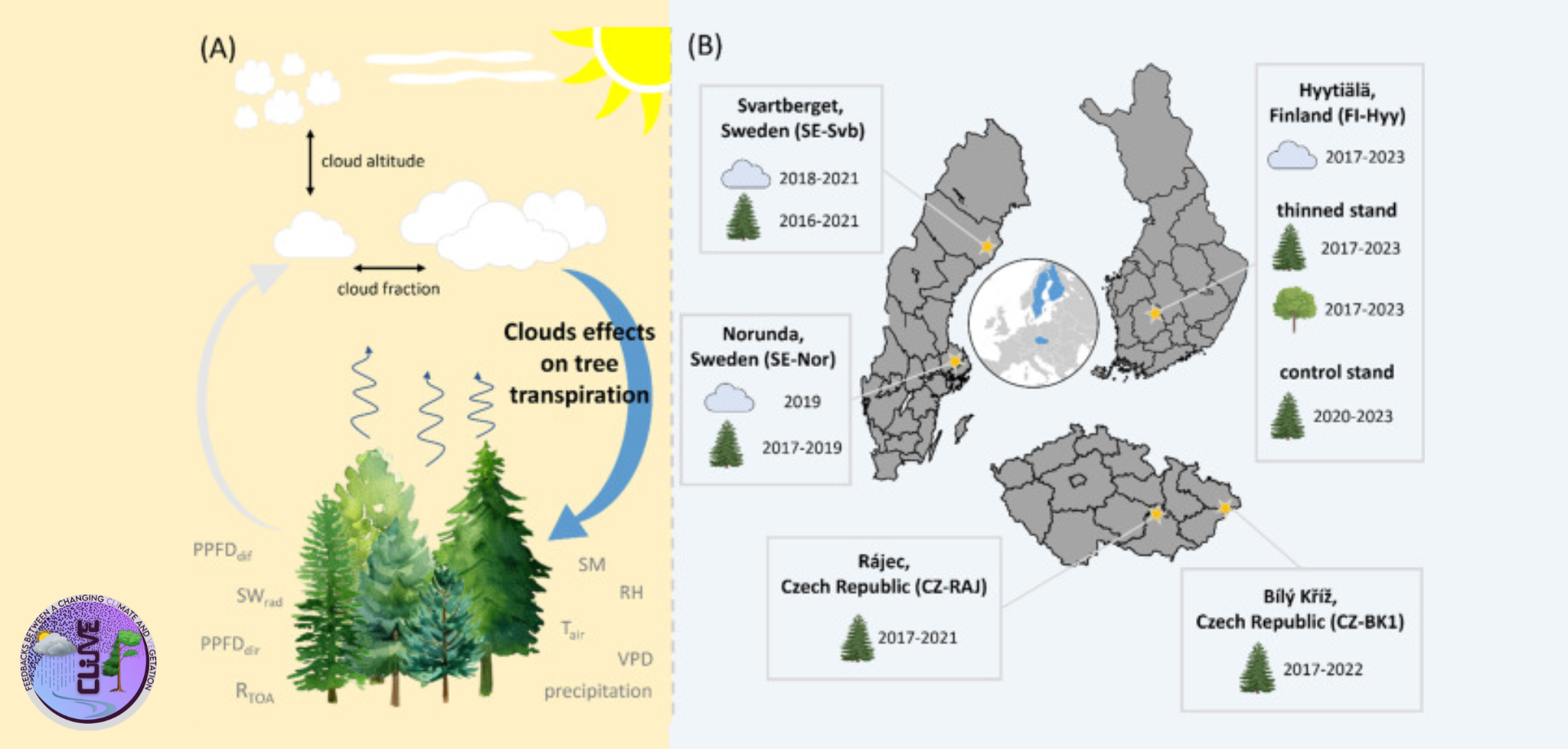
Distinct effects of low- and high-altitude clouds on transpiration
Cloud characteristics, especially altitude, play a key role in regulating forest transpiration. Using long-term sap flow and cloud observations from European boreal and temperate forests, a recent study by Talvinen et al. shows that not all clouds influence trees in the same way.
Low-altitude clouds tend to suppress transpiration by reducing incoming solar radiation, which limits stomatal activity*. In contrast, high-altitude clouds have minimal impact, and under certain conditions, can even coincide with higher sap flow due to increased diffuse light within the canopy.
The influence of environmental drivers such as atmospheric dryness, radiation, and soil moisture also shifts depending on cloud conditions, indicating that transpiration responses are context-dependent rather than uniform.
Importantly, a decline in low-level cloud cover has been observed over boreal regions. This trend may lead to a measurable increase in forest water release to the atmosphere, suggesting that changes in cloud patterns could strengthen feedbacks within the climate system.
Overall, the study highlights the need to consider cloud type (not just cloud presence) when assessing forest–atmosphere interactions and future hydrological changes.
*stomatal activity: how tiny pores on the surface of leaves, called stomata, open and close to regulate gas exchange between the plant and the atmosphere