Contribution to recent review papers on polar aerosol processes
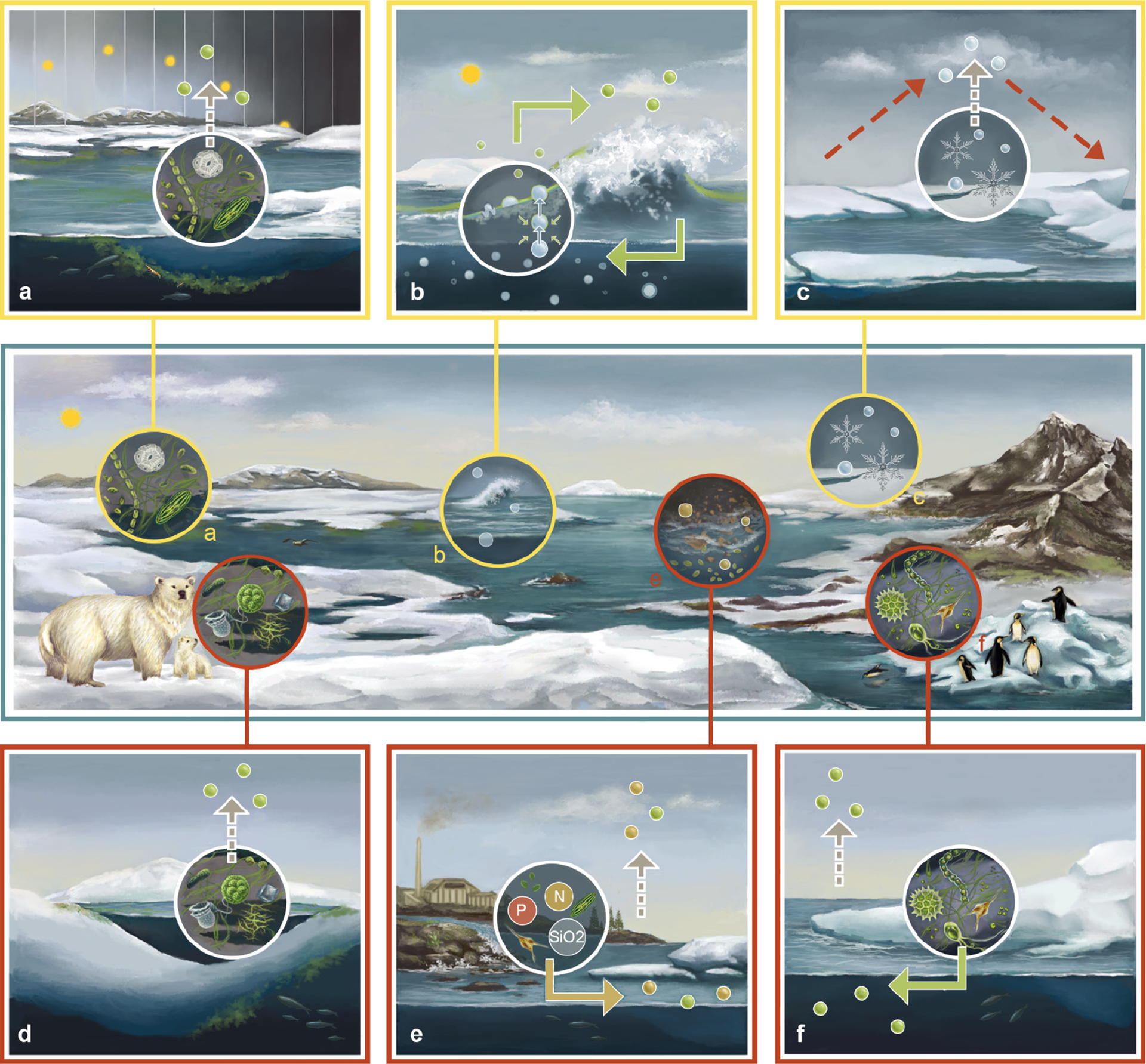
Two recent studies co-authored by CERTAINTY team members that have participated and contributed to the Cice2Clouds SCOR working group have been published. These papers and the working group are improving our understanding of how the polar oceans, sea ice, and the associated atmospheric particles form and behave in polar regions and influence clouds. Natural aerosols from the polar oceans have a key, but uncertain, role in regulating clouds, radiation, and ultimately climate at the poles. This is especially true in the Arctic because the region is warming rapidly and sea ice is declining. Understanding how natural aerosol sources respond to environmental change is critical for improving climate predictions. These two community papers synthesize current knowledge and highlight major uncertainties in (1) polar primary aerosols and the (2) biogenic sulfur cycle.
1. Role and Uncertainties of Primary Aerosols in Polar Climate Systems
Creamean et al. reviews the role of primary aerosols in polar regions and their influence on the climate system. These particles (including sea salt, organic matter, and biological material) are emitted from the ocean, sea ice, and snow through processes such as wave breaking and blowing snow. Once in the atmosphere, they affect radiation, atmospheric chemistry, and cloud formation by acting as cloud condensation nuclei and ice-nucleating particles. This paper emphasizes that many emission mechanisms, atmospheric transformations, and climate impacts remain poorly understood due to limited observations and uncertain representation in models. As polar environments change rapidly, improving measurements, models, and interdisciplinary collaboration will be essential to better predict aerosol–cloud interactions and climate feedbacks.
2. The polar biogenic sulfur cycle and its climate implications
Ishino et al. examines how polar oceans and sea ice produce sulfur gases such as dimethyl sulfide and methanethiol. These gases are released by marine microorganisms and can form atmospheric particles that influence cloud properties. Sea ice plays a dual role: it provides habitats for microorganisms that produce these gases, but it can also limit their release into the atmosphere. Current climate models do not adequately represent these processes (particularly sulfur production within sea ice and the role of methanethiol), leading to large uncertainties in predicted climate effects. The paper therefore calls for improved observations and better model representations of the ocean-ice-atmosphere sulfur cycle to understand how ongoing sea-ice loss may alter the polar aerosols, clouds, and climate.
Together, these studies highlight the importance of natural aerosol sources in polar regions and the need for better observations and models to understand how changing sea-ice environments may influence clouds and climate in the future.