FireMIP in CMIP7: Understanding of fire-climate interactions
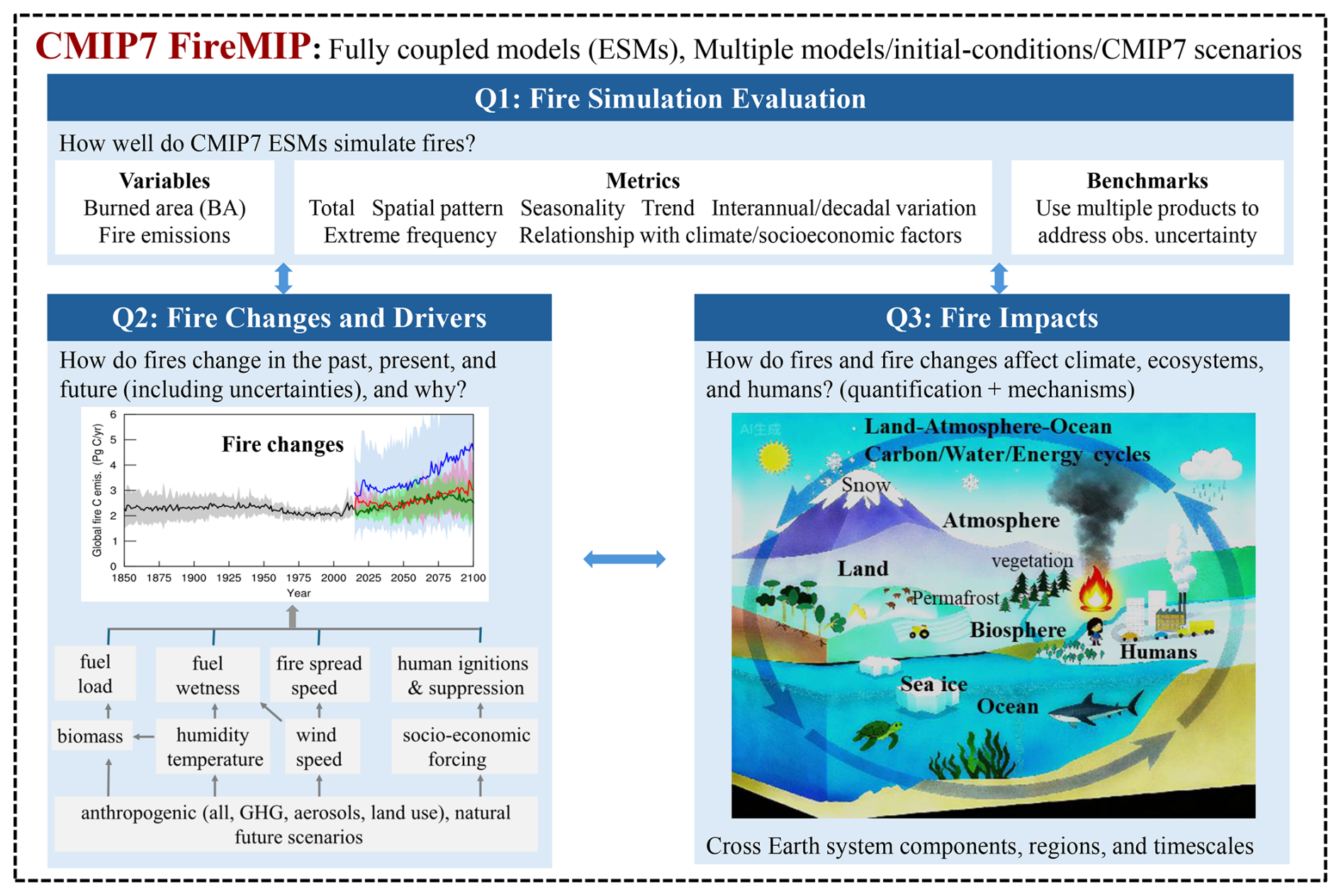
A recent paper by Li et al., co-authored by Apostolos Voulgarakis, who leads the Technical University of Crete’s contribution to CERTAINTY, presents FireMIP within CMIP7, a new framework for studying fire as an important part of the Earth system. While previous FireMIP studies mainly used offline vegetation models, CMIP7 will use fully coupled Earth system models to better capture interactions between fire, climate, ecosystems, oceans, atmosphere, and human systems.
The project aims to understand how fire regimes have changed and may change in the future, identify their natural and human drivers, and quantify their impacts and feedbacks across the Earth system. By using multi-model, multi-initial-condition, and multi-scenario ensembles, FireMIP will also better assess uncertainties. Overall, it seeks to improve understanding of fire-climate interactions and provide stronger scientific support for fire management, climate mitigation, ecosystem conservation, and environmental policy.