Tracking 100 years of atmospheric aerosols
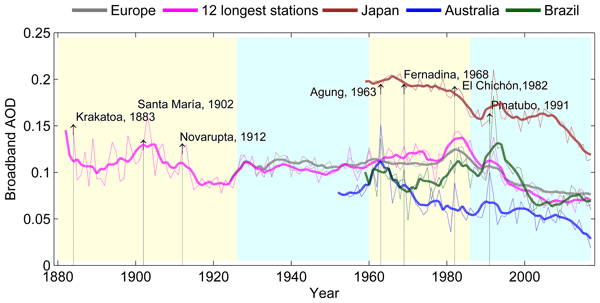
Atmospheric aerosols are an important source of uncertainty in climate projections, but reliable long-term observations are scarce, especially before the satellite era. A new study by Wandji Nyamsi et al. reconstructs aerosol optical depth back to the early 1900s using historical sunshine duration and cloud-cover observations from around 2,700 sites worldwide.
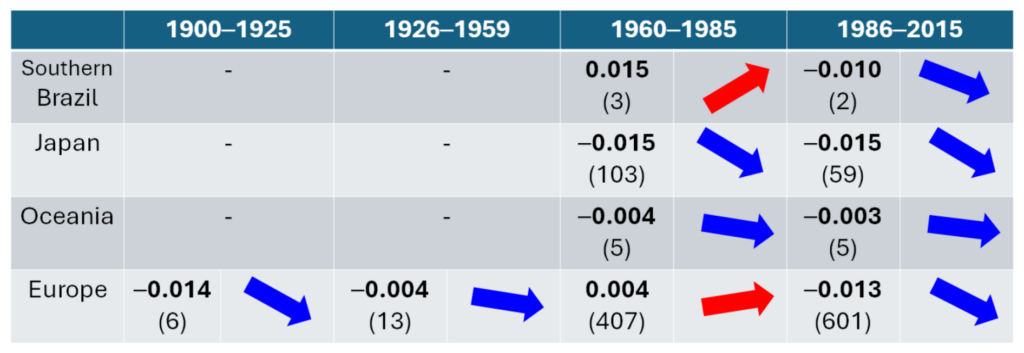
The results reveal strong regional differences in aerosol trends. In Europe, aerosol levels declined from 1926 to 1959, suggesting an early “brightening” phase, before increasing during the 1960–1985 “dimming” period. Japan, in contrast, experienced a strong decline in aerosol levels during this period, likely reflecting the positive effects of air-quality policies introduced from 1960 onwards. From 1986 onwards, aerosol levels generally decreased across all studied regions.
By extending aerosol records more than a century into the past, the paper provides valuable new evidence for understanding dimming and brightening and for improving climate models and estimates of aerosol effects on climate.