Can rime splintering explain ice production in Arctic mixed-phase clouds?
Arctic mixed-phase clouds play an important role in climate, yet the processes that control their ice formation remain difficult to represent in models. A new study by Raatikainen et al. investigates whether rime splintering (see below) can explain the unusually high ice crystal concentrations observed in Arctic clouds during the ACLOUD campaign.
Rime splintering is a secondary ice production process in which ice particles collect (or “rime”) supercooled liquid droplets. Under favorable conditions, particularly around −5 °C, this process can cause tiny fragments of ice to break off and form new ice crystals. In this way, a small number of ice-nucleating particles can trigger the production of many more ice crystals.
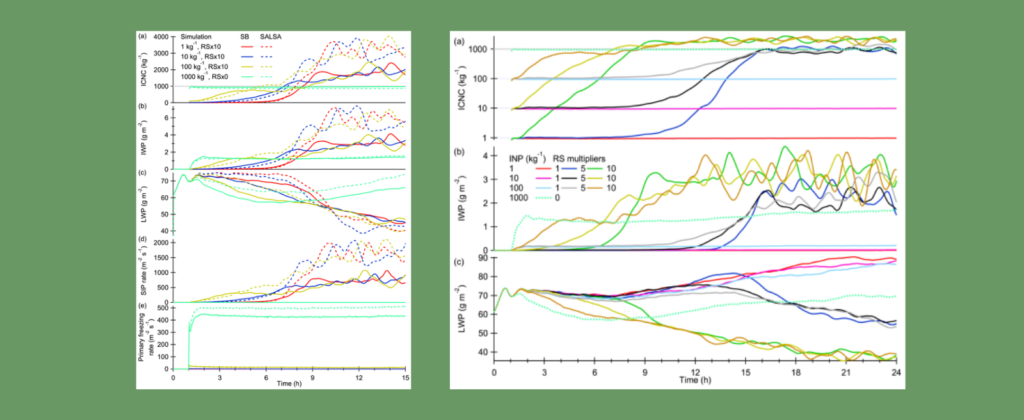
Large-eddy simulations show that the standard rime-splintering parameterization produces too little secondary ice. Increasing its efficiency by a factor of ten allowed the simulations to reproduce observed ice concentrations and showed that secondary ice production can become self-sustaining, largely independent of the initial ice-nucleating particles.
However, the results also demonstrate that ice production is highly sensitive to cloud temperature, droplet concentration, and the microphysical assumptions used in models. With alternative parameterizations and slightly cooler cloud conditions, the observed ice concentrations could be reproduced without artificially increasing rime splintering.
Overall, the study highlights the important role of secondary ice production in maintaining Arctic mixed-phase clouds and shows that improving its representation is essential for more realistic cloud and climate modelling.