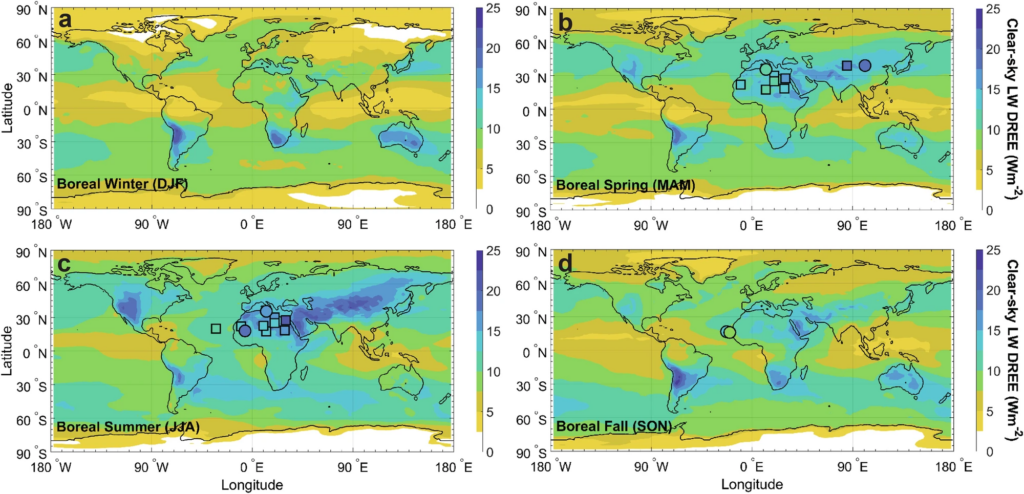
Desert dust warming exceeds model estimates
A recent study by Kok, J.F. et al. investigates how desert dust affects Earth’s climate through interactions with longwave radiation. Using a model based on observational data, the authors estimate that dust produces a global longwave radiative warming effect* of +0.25 ± 0.06 W m⁻², nearly twice the value represented in most climate models. The discrepancy arises because many models neglect longwave scattering and underestimate the abundance of super-coarse dust particles. These limitations lead to biases in simulated surface energy balance, clouds, precipitation, and atmospheric circulation.
While the overall net radiative effect* of dust remains uncertain at the global scale, the results show that accurately representing dust–radiation interactions is essential for reliable climate and weather predictions.
*Radiative effect refers to the change in Earth’s energy balance caused by a substance or process altering incoming or outgoing radiation, leading to either warming or cooling.